Self-awareness and decision-maker responsibility
Can you separate your own taste, fears, and beliefs from how the customer actually decides?
Know yourself · pp. 8–2350 scenarios · 10 measurement areas
In fifty business situations, choose how you would decide. Based on your answers, you receive feedback on ten areas: which customer perspectives you consider, what data you rely on, and how you use these in marketing.
Ten measurement areas
Each sub-score relates to a specific chapter in the Online Marketing és Pszichológia book. You can start reading at the suggested pages if questions arise in that topic during your work.
Can you separate your own taste, fears, and beliefs from how the customer actually decides?
Know yourself · pp. 8–23Do you treat marketing as a complete business decision system, or mainly as a series of advertising surfaces and campaign tactics?
What is marketing? · pp. 24–26Do you distinguish between reach, attention, understanding, memory, and brand-associated recall?
Psychology and advertising psychology · pp. 27–40Do you use types as flexible hypotheses, and do you differentiate based on buying situation, motivation, and behavior?
Typologies, type theories · pp. 41–56Do you understand how need, desire, risk, emotion, attitude, and actual behavior are connected?
Emotions and traits · pp. 57–70Are your personas built from traceable research, and do they include the situations that trigger decisions, objections, and customer language?
Buyer Persona · pp. 71–87Do you connect persuasion principles to real buyer obstacles, verifiable claims, and long-term trust?
Advertising · pp. 88–129Do you align the channel, format, and message with the audience's intent, attention state, and decision stage?
Online advertising channels · pp. 130–160Do you consistently build recognizability, credibility, and a brand promise that is reinforced after purchase?
Brand Building · pp. 161–167Do you direct campaigns with a hypothesis, baseline value, business metrics and documented lessons?
Starter campaign template · pp. 168–206What does maturity mean?
One can be informed about influence principles while still planning campaigns based on intuition. The test therefore shows three complementary cross-sections.
Do you recognize the psychological and marketing processes behind customer reactions?
Which source do you choose in the situational questions to support your decision?
Which solution do you choose in situations regarding offers, communication, and measurement?
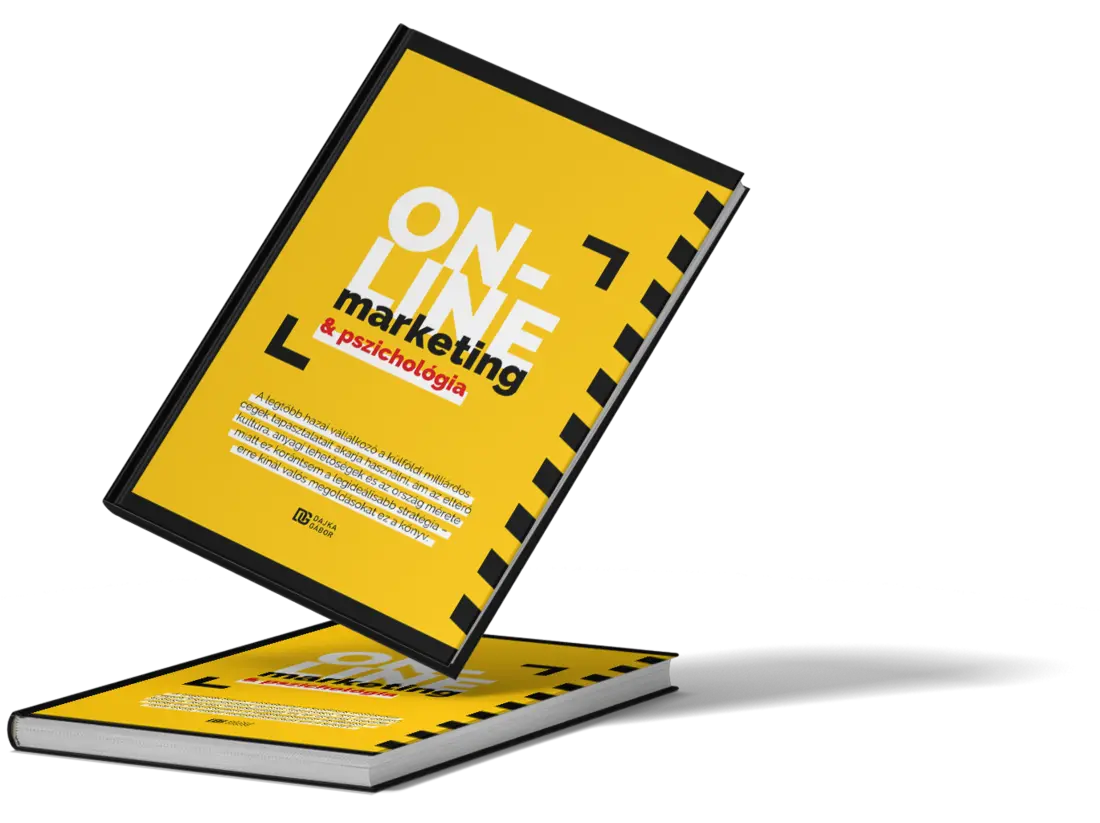
Reading recommendation for the book
For the three reading topics, you receive book page recommendations and a first practical task based on the mechanism understanding, evidence use, and application sub-scores calculated from your answers. The test does not verify your actual campaigns and sources.
Professional framework
The bank of 80 situational scenarios is based on the topics of Dajka Gábor's 206-page book, as well as related educational materials on communication, attention, perception, attitude, motivation, persuasion, and neuromarketing.
The system compiles a balanced set from the background bank of 80 questions.
Each measurement area provides a direct reading recommendation.
Scoring and saving take place in your own browser.
Scoring logic
Independently developed educational business self-assessment. Not a psychological diagnosis, not a certified psychometric measurement tool, and cannot be used for selection or suitability decisions. Text refinement: October 21, 2026. The decision log, button color, homepage clarity, and countdown status have been given more precise conditions; point values remain unchanged. When continuing a previously saved completion, review these answers.
Frequently asked questions
The test aggregates your answers to business situations across ten topics. It provides separate sub-scores for interpreting customer decisions, using evidence, and consistent application. The result reflects your choices; it does not verify your actual marketing work.
Situational self-assessment: you indicate what you would do in edited business situations. The result relates to your choices. You can compare your actual decision-making practice with specific campaigns and data.
For entrepreneurs, company leaders, in-house marketers, agency specialists, freelancers, and marketing students.
An aggregated situation assessment, ten sub-scores, three cross-sectional indicators, a response consistency flag, a book page recommendation, and a checkable 30-day plan. In your own source list, you can indicate what data you would compare the result with; the test does not verify the content or quality of the sources. You can create a seven-page result PDF, a manager action sheet, and two types of shareable result cards.
The three reading suggestions start from the lower sub-scores. In case of a tie, the editorial order of the topics decides; this is a reading order, not a proven business gap. Within the selected topic, the perspective with the lowest score determines the chapter, topic area, page range, and first task. In case of a tie among perspectives, the order of evidence use, application, and understanding applies. The page numbers refer to the first edition of the book from 2023.
The answers, scores, and comparisons remain exclusively in your own browser. The aggregated event counting running on the own server may record the number of test starts, completions, and offer clicks, as well as the provided UTM tags. It does not store names, email addresses, IP addresses, browser identifiers, or answer data.
At the end of the 30-day development plan, after important training, a new research process, an offer change, or a larger campaign cycle. The browser indicates the time for re-measurement, automatically compares the new result with the initial state, and draws a trend up to five measurements.
Each situation gives 0–3 points. The system selects a balanced 50 questions by area and measurement criterion from the background bank of 80 questions. The ten areas receive separate percentages, and the total score is relative to the 150-point maximum of the fifty answers.
The browser checks the completion time and the variety of answers. The flag helps to notice too fast or unusually uniform completion. It is not a psychometric reliability indicator.
No. The background bank contains 80 situations. Each new completion selects five questions per area so that the ratio of mechanism understanding, application, and evidence use remains the same.
No. It is a self-developed, educational business self-assessment tool that is not a certified psychometric instrument and is not suitable for diagnosis or personnel selection.
Your current operations matter
At the end, you receive ten sub-scores, precise book page recommendations, and a concrete 30-day development plan that can be followed locally.